What is SEO? Your Simple Guide to Getting Found Online

Have you ever wondered why some websites show up first when you search on Google? It’s not magic. It’s something called SEO. And today, I’m going to explain what is SEO in the simplest way possible.
Think of it like this. When you look for something in a huge library, you need a system to find it quickly. That’s exactly what SEO does for your website. It helps search engines find and show your website to people who are looking for what you offer.
I’ve been working with SEO for years. And I can tell you one thing. It’s not as scary or complicated as people make it sound. By the end of this guide, you’ll understand what SEO is and how you can start using it today.
What is SEO? The Simple Answer
SEO stands for Search Engine Optimization. That’s a fancy way of saying “making your website easy to find on Google and other search engines.”
Let me break this down even more. When someone types something into Google, they get a list of websites. SEO is what helps your website appear in that list. The better your SEO, the higher up you show.
It’s like having a great sign for your store. If your sign is clear and easy to see, more people will find your store. SEO does the same thing for your website online.
Here’s what SEO actually does:
- Helps Google understand what your website is about
- Makes your website show up when people search for related topics
- Brings more visitors to your website for free
- Builds trust with search engines and users
Why Does SEO Matter? The Numbers Don’t Lie
You might be thinking, “Do I really need to worry about SEO?” Let me share some eye-opening facts with you.
Over 53% of all website traffic comes from organic search. That means more than half of all people visiting websites found them through search engines like Google. That’s huge!
Here’s another shocking stat. The first result on Google gets 27.6% of all clicks. Think about it. If you’re not on the first page, you’re missing out on tons of potential customers.
And here’s one more that blew my mind. 91% of marketers say SEO gives them positive results. That means almost everyone who tries SEO sees their business grow.
But here’s the thing. Most people never look past the first page of Google results. In fact, only 0.63% of people click to the second page. This means if you’re not on page one, you might as well not exist online.
SEO isn’t just about getting traffic. It’s about getting quality traffic. These are people who are actively looking for what you offer. They’re ready to buy, learn, or take action.
How Do Search Engines Work? The Simple Version
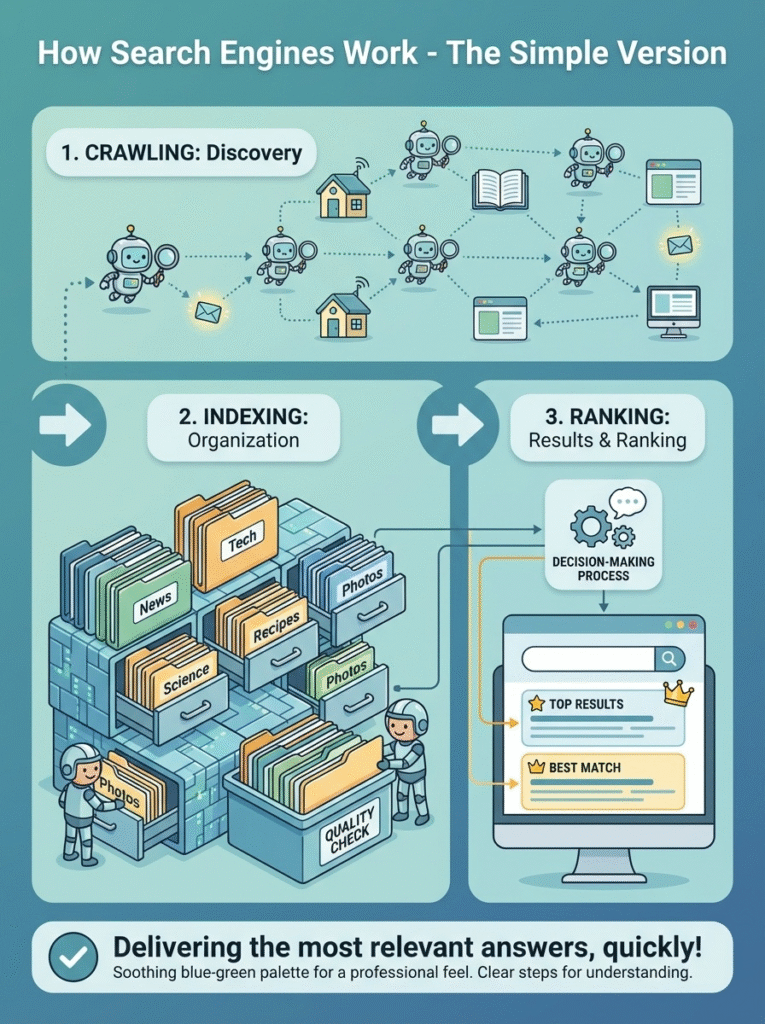
To understand what is SEO, you need to know how search engines work. Don’t worry. I’ll keep this super simple.
Search engines like Google do three main things:
- Crawling – The Discovery Phase
Imagine Google has millions of tiny robots called crawlers. These robots visit every website on the internet. They’re like scouts exploring new territory.
These crawlers follow links from one website to another. They read everything on each page. Then they report back to Google about what they found.
- Indexing – The Organization Phase
After the crawlers find your website, Google needs to organize all that information. This is called indexing. Think of it like creating a giant filing system.
Google takes all the information about your website and stores it in their massive database. They organize it by topic, quality, and relevance.
- Ranking – The Decision Phase
When someone searches for something, Google looks through their index. They decide which websites to show and in what order. This is called ranking.
Google uses over 200 factors to decide rankings. But don’t worry. You don’t need to know all of them. I’ll share the most important ones later.
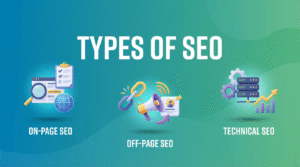
The 3 Types of SEO (Made Simple)
SEO has three main parts. Think of them as three legs of a stool. You need all three to be strong, or the stool falls over.
- On-Page SEO – What’s On Your Website
On-page SEO is everything you can control on your own website. It’s like decorating and organizing your store to make it attractive and easy to navigate.
This includes:
- Using the right keywords in your content
- Writing helpful titles and descriptions
- Making your content easy to read
- Using good headings and structure
- Adding relevant images with descriptions
- Off-Page SEO – What Others Say About You
Off-page SEO is about building your website’s reputation online. It’s like having other people recommend your business to their friends.
The main part of off-page SEO is getting backlinks. These are links from other websites that point to your website. Think of them as votes of confidence.
When high-quality websites link to you, it tells Google that your website is trustworthy and valuable.
- Technical SEO – Making Your Website Work Properly
Technical SEO makes sure your website works smoothly behind the scenes. It’s like making sure your store has good lighting, clean floors, and working doors.
This includes:
- Making your website load fast
- Ensuring it works on mobile phones
- Fixing broken links
- Making it secure with HTTPS
- Creating a sitemap for search engines
Key SEO Elements You Need to Know
Now let’s talk about the most important parts of SEO. These are the things that make the biggest difference.
Keywords – The Words People Search For
Keywords are the words and phrases people type into search engines. If someone searches for “best pizza near me,” then “best pizza near me” is a keyword.
Your job is to find out what keywords your customers use. Then you create content around those keywords. But here’s the trick. You need to use them naturally, not stuff them everywhere.
Quality Content – Give People What They Want
Content is anything you put on your website. Blog posts, product descriptions, videos, images. All of it is content.
Google loves websites that provide real value to users. This means:
- Answering questions people actually have
- Solving real problems
- Being accurate and up-to-date
- Writing in a way people can understand
Backlinks – Digital Recommendations
Remember backlinks? They’re still one of the most important ranking factors. When other websites link to yours, it’s like getting a recommendation.
But not all backlinks are equal. A link from a trusted, popular website is worth much more than a link from a random, unknown site.
User Experience – Make People Happy
Google wants to show websites that make users happy. This means your website should:
- Load quickly (under 3 seconds is ideal)
- Work perfectly on mobile devices
- Be easy to navigate
- Have clear, readable text
- Provide the information people are looking for
How to Get Started with SEO (5 Simple Steps)
Ready to start improving your SEO? Here’s my simple 5-step plan that anyone can follow.
Step 1: Research Your Keywords
Start by thinking about what your customers search for. Use free tools like Google’s Keyword Planner or Ubersuggest to find popular search terms in your industry.
Look for keywords that have decent search volume but aren’t super competitive. Long phrases (called long-tail keywords) are often easier to rank for.
Step 2: Optimize Your Website Pages
Take your most important pages and optimize them for your target keywords. This means:
- Including your keyword in the page title
- Using it in your main heading
- Mentioning it naturally throughout your content
- Writing a compelling meta description
Step 3: Create Helpful Content Regularly
Start a blog or resource section on your website. Write about topics your customers care about. Answer their common questions. Share useful tips and advice.
Aim for one new piece of content per week. Quality beats quantity every time.
Step 4: Fix Technical Issues
Use free tools like Google Search Console to find and fix technical problems. Common issues include:
- Slow loading pages
- Broken links
- Missing title tags or descriptions
- Mobile usability problems
Step 5: Build Your Online Reputation
Reach out to other websites in your industry. Offer to write guest posts or collaborate on content. This helps you earn those valuable backlinks.
Also, make sure your business is listed on Google My Business, Yelp, and other relevant directories.
Common SEO Mistakes to Avoid
I’ve seen people make the same SEO mistakes over and over. Here are the biggest ones to avoid.
Keyword Stuffing: Don’t cram your keyword into every sentence. It makes your content hard to read and Google will penalize you for it.
Buying Cheap Backlinks: Avoid services that promise hundreds of backlinks for $5. These low-quality links will hurt your rankings, not help them.
Ignoring Mobile Users: Over half of web traffic comes from mobile devices. If your website doesn’t work well on phones, you’re losing customers.
Expecting Instant Results: SEO takes time. Don’t expect to rank #1 overnight. Good SEO is a marathon, not a sprint.
Copying Content: Never copy content from other websites. Google can detect duplicate content and will rank original content higher.
Neglecting Page Speed: If your website takes more than 3 seconds to load, people will leave. Use tools like Google PageSpeed Insights to check and improve your site speed.
Conclusion
So, what is SEO? It’s simply the practice of making your website more visible and attractive to search engines and users. It’s about creating a better online experience for everyone.
The best part about SEO is that it brings you customers who are already looking for what you offer. Unlike paid ads, SEO traffic is free and keeps coming long after you’ve done the work.
Remember, you don’t need to become an SEO expert overnight. Start with the basics. Focus on creating helpful content that answers your customers’ questions. Make sure your website works well and loads fast. Be patient and consistent.
SEO might seem overwhelming at first, but it’s really just about common sense. Make your website helpful, trustworthy, and easy to use. The rest will follow naturally.
Ready to get started? Pick one thing from this guide and implement it today. Your future customers are out there searching for you. SEO helps them find you.
Frequently Asked Questions
How long does SEO take to work?
SEO typically takes 3-6 months to show significant results. It’s not instant like paid ads. Think of SEO like planting a garden. You need to plant seeds, water them, and wait for them to grow. The results are worth the wait because they last much longer.
Is SEO free?
SEO itself is free, but it requires time and effort. You don’t pay search engines to rank higher. However, you might spend money on tools, content creation, or hiring help. The traffic you get from SEO is completely free, unlike paid advertising.
Can I do SEO myself?
Absolutely! Many successful websites are optimized by business owners who learned SEO basics. Start with simple things like keyword research and creating good content. You can always hire experts later as your business grows. The fundamentals aren’t rocket science.
What’s the difference between SEO and paid ads?
SEO gets you free traffic from organic search results, but takes time to work. Paid ads get you immediate traffic but cost money for each click. SEO results last longer, while
ads stop working when you stop paying. Most successful businesses use both strategies together.
Do I need to hire an SEO expert?
Not necessarily, especially when starting out. Many small businesses successfully do their own SEO using free resources and tools. Consider hiring an expert if your business is competitive, you lack time, or you’re not seeing results after 6-12 months of trying.
How much does SEO cost?
DIY SEO can cost almost nothing except your time. Professional SEO services typically range from $500-$5,000+ per month, depending on your business size and competition. Many small businesses start with $1,000-$2,000 monthly budgets. Remember, SEO is an investment that pays long-term dividends.
Is SEO still relevant in 2024?
Yes, SEO is more important than ever! While search engines evolve, people still use Google billions of times daily to find information and products. As long as people search online, SEO will remain crucial. The basics haven’t changed much, just the techniques have gotten more sophisticated.
What’s the most important part of SEO?
Creating high-quality, helpful content is the most important part of SEO. Everything else supports this foundation. Google’s main goal is showing users the best, most relevant content for their searches. Focus on solving your audience’s problems, and technical optimizations become much more effective.
Can SEO guarantee a #1 ranking?
No legitimate SEO expert can guarantee #1 rankings. Google uses over 200 ranking factors and constantly updates its algorithm. Anyone promising guaranteed rankings is either lying or using risky tactics that could get your website penalized. Focus on steady improvement rather than unrealistic promises.
Do I need to know coding for SEO?
Basic SEO doesn’t require coding knowledge. Most important SEO tasks involve content creation, keyword research, and using user-friendly tools. However, some
technical SEO improvements might need coding help. Many website platforms like WordPress make SEO easier with plugins that handle the technical stuff for you.