Types of SEO: A Complete Guide to SEO Strategies

Have you ever felt overwhelmed when people talk about different types of SEO? You’re not alone! When I first started learning about search engine optimization, I thought SEO was just one thing. Boy, was I wrong.
It turns out there are actually several different types of SEO strategies. Each one focuses on a different part of making your website better for search engines. Think of it like building a house – you need different specialists for different jobs.
In this guide, I’ll walk you through all the main types of SEO in simple terms. By the end, you’ll understand which ones matter most for your website. No confusing jargon, just practical advice you can actually use.
Let’s dive in and make sense of this SEO puzzle together!
Why Are There Different Types of SEO?
You might wonder why SEO isn’t just one simple thing. Well, think about building a championship basketball team. You don’t just need great shooters – you need players who can defend, rebound, pass, and lead.
Search engines work the same way. They look at many different factors when deciding which websites to show first. Some factors are about your content, others are about how fast your site loads, and some are about what other websites say about you.
That’s why we have different types of SEO. Each type focuses on improving a specific area that search engines care about. When you combine them all, you get a website that performs much better in search results.
The Core Types of SEO You Need to Know
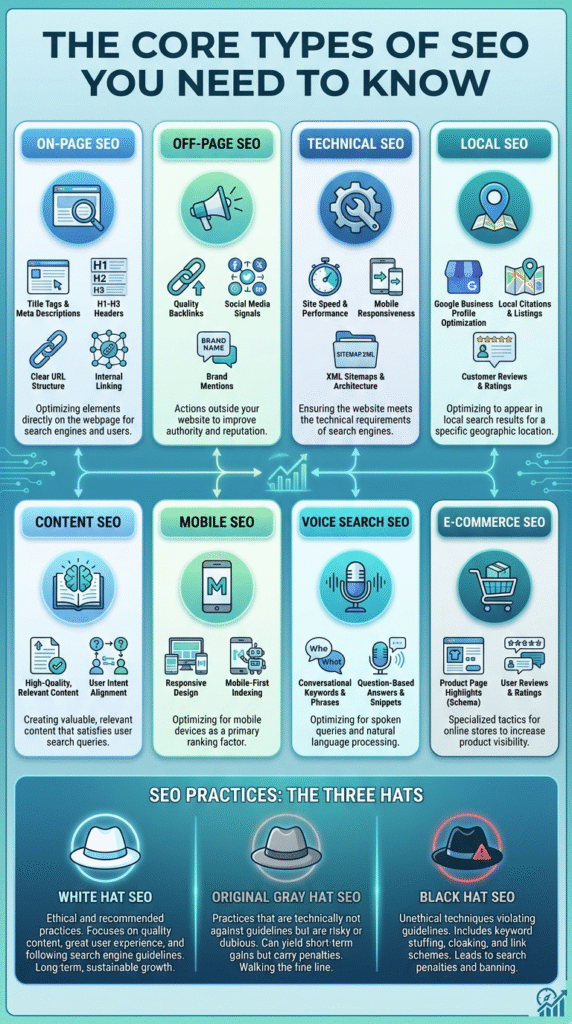
There are eight main SEO strategies that every website owner should understand. Each one plays a unique role in helping your site rank higher. Let me break them down for you in a way that’s easy to understand.
1. On-Page SEO
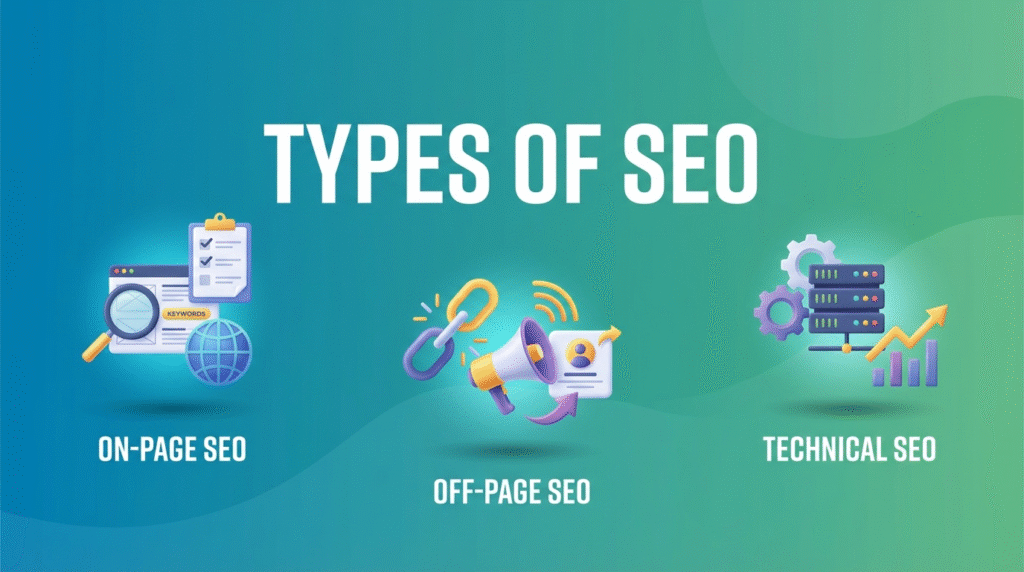
On-page SEO is everything you do directly on your website pages to make them search-engine friendly. It’s like decorating and organizing each room in your house so guests can easily find what they need.
This is often the first type of SEO people learn because you have complete control over it. You don’t need to ask anyone else for permission – you can just make changes and see results.
Here are the key elements of on-page optimization:
- Title tags and meta descriptions – The headlines and summaries people see in search results
- Header tags (H1, H2, H3) – The structure that organizes your content
- URL structure – Making your web addresses clear and descriptive
- Internal linking – Connecting your pages together logically
- Image optimization – Adding descriptions to photos and making them load fast
- Content quality – Writing helpful, detailed information
- Keyword placement – Using search terms naturally throughout your content
Let me give you a real example. Imagine you run a fitness blog and write an article about home workouts. Good on-page SEO would mean using a clear title like “10-Minute Home Workouts for Busy Parents,” organizing it with helpful headers, and including relevant terms like “quick exercises” and “no equipment needed” naturally in your writing.
The beauty of on-page SEO is that small changes can make a big difference. Fix your titles, improve your content, and organize everything clearly – you’ll often see improvements within weeks.
2. Off-Page SEO
Off-page SEO is all about building your website’s reputation across the internet. Think of it like networking in real life – the more respected people who know and recommend you, the more credible you become.
This type of SEO happens outside your website, which makes it trickier to control. But it’s incredibly powerful for building trust with search engines.
Here are the main components of off-page SEO:
- Backlinks from quality sites – Other websites linking to your content
- Social media signals – Shares, likes, and comments on social platforms
- Brand mentions – Other websites mentioning your business name
- Guest posting – Writing articles for other relevant websites
- Influencer partnerships – Collaborating with people who have large audiences
For example, if you create a comprehensive guide about sustainable gardening and three popular gardening blogs link to it as a helpful resource, that’s powerful off-page SEO. Those links tell search engines that your content is valuable and trustworthy.
The key is focusing on quality over quantity. One link from a respected website in your field is worth more than dozens of links from random, unrelated sites.
3. Technical SEO
Technical SEO is like the foundation and plumbing of your house. You might not see it, but if it’s broken, nothing else works properly.
This involves making sure search engines can easily crawl, understand, and index your website. It’s the behind-the-scenes work that makes everything else possible. Without solid technical SEO, even the best content won’t rank well.
The essential elements of technical SEO include:
- Site speed optimization – Making your pages load quickly
- Mobile responsiveness – Ensuring your site works perfectly on phones
- XML sitemaps – Providing search engines with a map of your content
- HTTPS security – Encrypting data between your site and visitors
- Structured data – Adding code that helps search engines understand your content
- Crawlability – Making sure search engine bots can access all your important pages
Here’s a concrete example: Let’s say you have an online photography portfolio, but it takes 8 seconds to load each page. Visitors will leave before seeing your work, and search engines will rank you lower. Technical SEO would involve compressing your images, optimizing your code, and choosing faster hosting to get load times under 3 seconds.
Don’t worry if technical SEO sounds intimidating. Many issues can be fixed with simple plugins or by asking your web developer for help. The investment is always worth it because it improves every other SEO effort you make.
4. Local SEO
Local SEO helps businesses show up when people search for services in their area. If you have a physical location or serve customers in specific cities, this type of SEO is crucial for your success.
When someone searches “dentist near me” or “best Mexican food in Seattle,” local SEO determines which businesses appear first. It’s especially important because local searches often lead to immediate visits or phone calls.
The key components of local search optimization are:
- Google Business Profile – Your free listing on Google Maps and search results
- Local citations – Mentions of your business name, address, and phone number on other websites
- Online reviews – Customer feedback on Google, Yelp, and other platforms
- Local keywords – Including your city and neighborhood names in your content
- NAP consistency – Making sure your Name, Address, and Phone number match everywhere online
Consider a small veterinary clinic in Austin, Texas. Good local SEO would mean having a complete Google Business Profile with photos and current hours, getting listed in local directories, encouraging happy customers to leave reviews, and creating content about “pet care in Austin” or “emergency vet services near downtown Austin.”
The beautiful thing about local SEO is that you’re competing against fewer businesses. Instead of competing globally, you’re mainly competing against other businesses in your area, which makes it much more achievable for small companies.
5. Content SEO
Content SEO focuses on creating valuable, search-friendly content that answers what people are actually looking for. It’s about understanding your audience and providing exactly what they need.
This goes beyond just writing articles. Content SEO means creating any type of content – blog posts, videos, infographics, or guides – that serves a real purpose and ranks well in search results.
The core elements of effective content SEO include:
- High-quality content – Comprehensive, accurate, and helpful information
- User intent matching – Understanding what searchers really want to accomplish
- E-E-A-T principles – Demonstrating Experience, Expertise, Authoritativeness, and Trustworthiness
- Content freshness – Regularly updating and adding new information
- Comprehensive coverage – Covering topics thoroughly rather than superficially
For instance, if you notice people searching “how to train a puppy to sleep through the night,” great content SEO would involve creating a detailed guide covering different training methods, common challenges, timelines for results, and troubleshooting tips. You’d research what questions people really have and answer them completely.
Remember, search engines can now understand content quality much better than before. They reward content that truly helps people, not just content that’s stuffed with keywords.
6. Mobile SEO
Mobile SEO ensures your website works perfectly on smartphones and tablets. With over 60% of searches now happening on mobile devices, this isn’t optional anymore – it’s essential.
Google uses mobile-first indexing, which means they primarily look at the mobile version of your site when deciding how to rank you. If your site doesn’t work well on phones, you’re missing out on most potential visitors.
The critical aspects of mobile SEO include:
- Responsive design – Your site automatically adjusts to any screen size
- Mobile-first indexing – Google primarily uses your mobile site for ranking
- Touch-friendly navigation – Buttons and links that work well with fingers
- Fast loading on mobile – Optimizing for slower mobile internet connections
Imagine you run an online cooking blog. Poor mobile SEO would mean tiny text that’s hard to read, recipe ingredients that require zooming and scrolling, and images that take forever to load. Good mobile SEO would mean clear, readable text, easy-to-follow recipe formats, and images that load quickly even on slower connections.
The easiest way to check your mobile SEO is to visit your website on your phone. If anything feels clunky or hard to use, your visitors and search engines feel the same way.
7. Voice Search SEO
Voice search SEO optimizes your content for people using Siri, Alexa, Google Assistant, and other voice-activated devices. As smart speakers become more popular, this type of optimization is growing rapidly.
Voice searches are different from typed searches because people speak more naturally and often ask complete questions. Instead of typing “best Italian restaurant Chicago,” they might say “What’s the best Italian restaurant near me?”
Key elements of voice search optimization include:
- Conversational keywords – Natural phrases people actually speak
- Question-based content – Answering who, what, where, when, why, and how questions
- Featured snippet optimization – Structuring content to appear in position zero
- Local intent – Many voice searches are for nearby businesses or services
For example, if you’re a financial advisor, voice search SEO would mean creating content that answers questions like “How much should I save for retirement?” or “What’s the difference between a 401k and an IRA?” in clear, conversational language that a voice assistant could easily read aloud.
The key is thinking about how people actually talk rather than how they type. Write like you’re having a conversation with a friend who asked you a question.
8. E-commerce SEO
E-commerce SEO is specifically designed for online stores and focuses on product pages, category pages, and the unique challenges of selling products online. It combines regular SEO with conversion optimization.
Online stores face unique SEO challenges like duplicate product descriptions, seasonal inventory changes, and the need to rank for thousands of different products. E-commerce SEO addresses these specific issues.
Essential elements of e-commerce SEO include:
- Product page optimization – Unique descriptions, high-quality images, and clear specifications
- Category pages – Helpful organization that both users and search engines understand
- User reviews – Customer feedback that builds trust and provides fresh content
- Product schema markup – Structured data that helps search engines understand your products
- Faceted navigation – Filters that help customers find products without creating SEO problems
Consider an online electronics store selling laptops. Good e-commerce SEO would mean each laptop has a unique, detailed description highlighting key features, customer reviews are prominently displayed, and category pages like “Gaming Laptops Under $1000” provide helpful buying guidance rather than just listing products.
The goal is making it easy for both customers and search engines to understand what you sell and why someone should buy from you rather than a competitor.
White Hat vs. Black Hat vs. Grey Hat SEO
Just like in old Western movies, SEO practitioners wear different colored hats that represent their approach to optimization. Understanding these differences helps you choose the right path for long-term success.
White Hat SEO follows search engine guidelines and focuses on providing value to users. It’s like being an honest student who studies hard and earns good grades through legitimate effort. This approach takes longer but builds sustainable success.
Black Hat SEO uses manipulative tactics that violate search engine rules. Think of it like cheating on a test – you might get short-term results, but eventually you’ll get caught and face serious consequences including getting banned from search results entirely.
Grey Hat SEO falls somewhere in between, using tactics that aren’t explicitly forbidden but aren’t exactly encouraged either. It’s riskier than white hat but not as dangerous as black hat. Most SEO experts recommend avoiding grey hat tactics and sticking with proven white hat methods.
How These Types Work Together
Here’s the thing about the different types of SEO – they work best when you use them together, like musicians in a symphony orchestra. Each instrument plays its own part, but the magic happens when they all work in harmony.
For example, your technical SEO ensures search engines can crawl your site, your on-page SEO makes individual pages rank well, your content SEO provides value to visitors, and your off-page SEO builds authority and trust. Remove any one element, and the whole performance suffers.
I’ve seen many websites that excel in one area but ignore others. They might have amazing content but terrible technical SEO, so their pages load slowly and rank poorly. Or they might have perfect technical setup but weak content, so visitors leave immediately. The most successful websites pay attention to all SEO strategies and improve them gradually over time.
Which Types of SEO Should You Focus On?
If you’re feeling overwhelmed, don’t worry! You don’t need to master everything at once. The best approach depends on your business type and current situation.
For small local businesses like restaurants, dental offices, or repair services, start with local SEO, basic on-page optimization, and technical SEO. These three will give you the biggest impact for serving customers in your area.
If you run a blog or content-focused website, prioritize content SEO, on-page optimization, and off-page SEO. Focus on creating amazing content that people want to share and link to.
For e-commerce stores, begin with e-commerce SEO, technical SEO, and on-page optimization. Make sure your products can be found and your site works smoothly for shoppers.
Remember, SEO is a marathon, not a sprint. Pick 2-3 types to focus on first, get good at those, then gradually expand your efforts to other areas.
Conclusion
Understanding the different types of SEO is like having a complete toolbox instead of just a hammer. Each type serves a specific purpose, and knowing when and how to use them makes all the difference in your search engine success.
The beautiful thing about SEO is that you don’t need to be perfect right away. Start with the basics, focus on providing real value to your audience, and gradually improve different aspects of your website over time. Even small improvements in each area can add up to significant results.
Most importantly, remember that all successful SEO strategies start with understanding your audience and creating something genuinely helpful for them. Search engines are getting better at recognizing and rewarding websites that truly serve their users. Focus on that, and the rankings will follow.
Frequently Asked Questions About Types of SEO
What are the 4 main types of SEO?
The four core types are on-page SEO (optimizing individual pages), off-page SEO (building external authority), technical SEO (ensuring your site works properly), and local SEO (targeting local customers). These form the foundation that most other SEO strategies build upon.
Which type of SEO is most important?
There’s no single “most important” type because they all work together. However, technical SEO often needs to be addressed first because if search engines can’t properly crawl and index your site, nothing else matters. Think of it as the foundation that supports everything else.
What’s the difference between on-page and off-page SEO?
On-page SEO involves everything you control directly on your website – content, titles, structure, and optimization. Off-page SEO happens outside your site and focuses on building authority through backlinks, social signals, and mentions from other websites.
Do I need to use all types of SEO?
Not necessarily all at once, but eventually most websites benefit from multiple types. Start with the ones most relevant to your business type and gradually expand. A local business might focus on local and on-page SEO first, while a blog might prioritize content and off-page SEO.
What is white hat SEO?
White hat SEO refers to ethical optimization practices that follow search engine guidelines and focus on providing genuine value to users. These techniques are safe, sustainable, and build long-term success without risk of penalties.
Is technical SEO hard to learn?
Basic technical SEO is more accessible than many people think. Simple improvements like installing security certificates, optimizing images, and using SEO plugins can make a big difference. For complex issues, you can often hire specialists or use automated tools.
How long does each type of SEO take to show results?
Technical SEO improvements can show results within weeks, on-page SEO typically takes 1-3 months, while off-page SEO and content SEO often need 3-6 months or longer. Local SEO can show faster results for businesses in less competitive areas.
What is local SEO best for?
Local SEO is essential for any business that serves customers in specific geographic areas – restaurants, medical offices, repair services, law firms, and retail stores. It helps you appear when people search for services “near me” or in your city.
Can I do SEO myself or do I need an expert?
You can definitely learn and implement basic SEO yourself, especially on-page and content SEO. Many small businesses successfully handle their own SEO using online resources and tools. However, technical SEO or competitive markets might benefit from professional help.
What’s the difference between content SEO and on-page SEO?
Content SEO focuses specifically on creating valuable, search-friendly content that matches user intent. On-page SEO includes content but also covers technical elements like title tags, meta descriptions, URL structure, and internal linking – basically everything on individual pages.
Is mobile SEO really necessary?
Absolutely! With over 60% of searches happening on mobile devices and Google using mobile-first indexing, mobile SEO isn’t optional anymore. If your site doesn’t work well on phones, you’re likely losing both visitors and rankings.
What is voice search optimization?
Voice search optimization means creating content that answers the conversational questions people ask their smart speakers and voice assistants. It focuses on natural language, question-based content, and featured snippet optimization since voice devices often read these answers aloud.