What is On-Page SEO? Your Complete Guide to Optimizing Web Pages

I still remember the day I first heard about what is on page seo. I was staring at my computer screen, completely confused. My website had great content, but nobody was finding it on Google. Then my friend Sarah mentioned something called “on-page SEO,” and I had no clue what she meant.
I thought SEO was just one big thing. Turns out, I was wrong. On-page SEO is like decorating the inside of your house – it’s all about making each room (or web page) look perfect for your visitors and for Google’s robots that come to check it out.
If you’re feeling lost like I was, don’t worry. I’m going to explain what is on page seo in simple terms. By the end of this guide, you’ll know exactly how to make your web pages shine.
What is On-Page SEO?
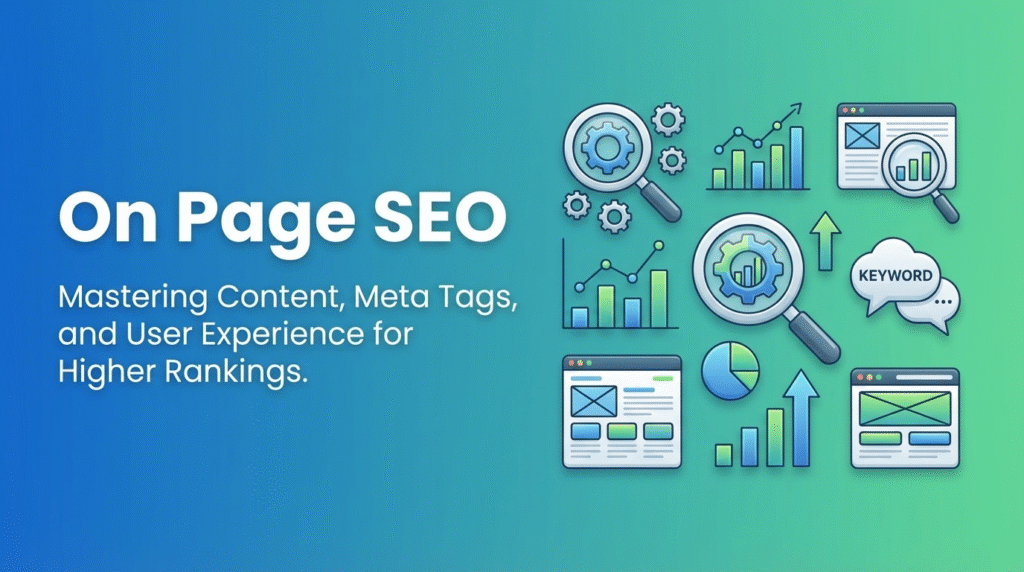
On-page SEO is everything you do directly on your website to help it rank higher in search results. Think of it like organizing your bedroom. You arrange your books, clean your desk, and put everything in the right place so visitors feel comfortable.
On-page optimization includes things like your page titles, headings, content, images, and links. It’s all the stuff that happens on your actual web page. This is different from off-page SEO, which happens outside your website.
When I learned about what is on page seo, it was like someone gave me a roadmap. Suddenly, I knew exactly what to fix on each page to make Google happy.
Why On-Page SEO Matters More Than You Think
Here’s something that shocked me: 75% of people never scroll past the first page of Google results. That means if your page isn’t optimized, you’re basically invisible.
But here’s the good news. Websites with strong on-page SEO get 53% more organic traffic than those without it. That’s like having a store on the busiest street versus hiding in a back alley.
On-page SEO also makes your website better for real people. When you organize your content properly, visitors can find what they need quickly. It’s a win-win situation.
I learned this the hard way. Before I understood what is on page seo, my bounce rate was terrible. People would land on my pages and leave immediately because everything was messy and hard to read.
The Essential Elements of On-Page SEO
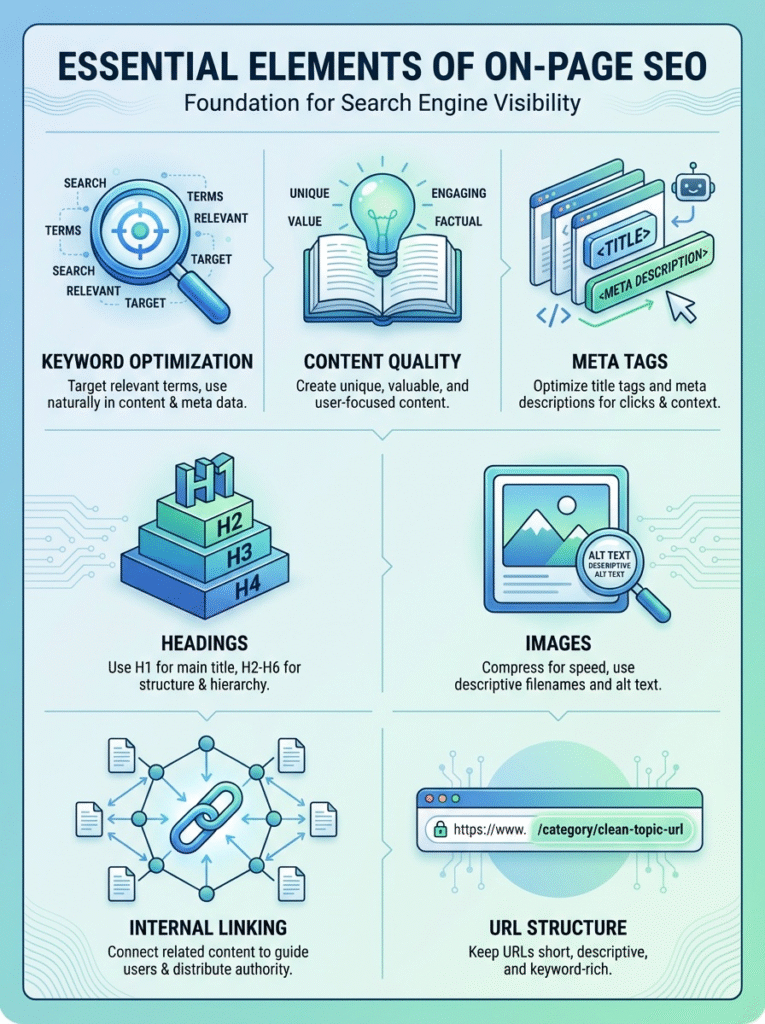
Let me break down the key parts of on-page optimization. Think of these as the different rooms in your house that need attention.
Title Tags: Your Page’s Front Door Sign
Your title tag is like the sign on your front door. It tells people (and Google) what your page is about. You see it in browser tabs and search results.
A good title tag should be 50-60 characters long and include your main keyword. For example, instead of “My Blog Post,” use “How to Bake Chocolate Chip Cookies in 30 Minutes.”
I used to write boring titles like “About Us” or “Services.” Now I write titles that actually describe what people will find on the page.
Meta Descriptions: Your Page’s Preview
The meta description is like a movie trailer for your page. It appears under your title in search results. While it doesn’t directly affect rankings, it helps people decide whether to click.
Keep meta descriptions under 160 characters. Make them interesting and include your keyword naturally. Think of it as your elevator pitch for that page.
Headings: Your Content’s Filing System
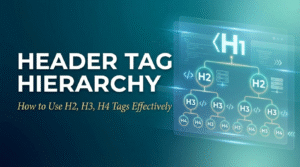
Headings (H1, H2, H3) are like labels on filing cabinets. They help organize your content so both readers and Google can understand the structure.
Use only one H1 per page (your main title). Then use H2s for major sections and H3s for subsections. It’s like creating an outline for a school essay.
Content Quality: The Heart of Your Page
Your content is like the main course at a restaurant. Everything else is just decoration. Google looks for content that shows Expertise, Experience, Authoritativeness, and Trustworthiness (E-E-A-T).
Write for real people, not robots. Answer their questions completely. If someone searches for “how to change a tire,” don’t just give them a two-sentence answer. Give them a complete, helpful guide.
Keywords: Your Content’s Road Signs
Keywords are like road signs that guide Google to your content. But don’t stuff them everywhere like spam. Use them naturally, the way you’d talk to a friend.
Include your main keyword in your title, first paragraph, and a few headings. Also use related keywords (called LSI keywords) that make sense in context.
URL Structure: Your Page’s Address
Your URL is like your home address. Make it clear and easy to understand. Instead of “mysite.com/p?id=12345,” use “mysite.com/chocolate-chip-cookies.”
Keep URLs short, use hyphens between words, and include your main keyword when it makes sense.
Internal Links: Your Website’s Hallways
Internal links connect your pages together like hallways connect rooms in a house. They help visitors navigate and show Google which pages are most important.
Link to other relevant pages on your site when it adds value for readers. Use descriptive anchor text instead of “click here.”
Image Optimization: Making Pictures SEO-Friendly
Images need optimization too. Use descriptive file names instead of “IMG_12345.jpg.” Add alt text that describes what’s in the image for people who can’t see it.
Also compress your images so they load faster. Nobody wants to wait for slow pictures to load.
Page Speed: The Need for Speed
Page speed is like the speed of service at a restaurant. If it’s too slow, people leave. Google considers page speed a ranking factor, and 53% of mobile users abandon pages that take longer than 3 seconds to load.
On-Page SEO vs Off-Page SEO: What’s the Difference?
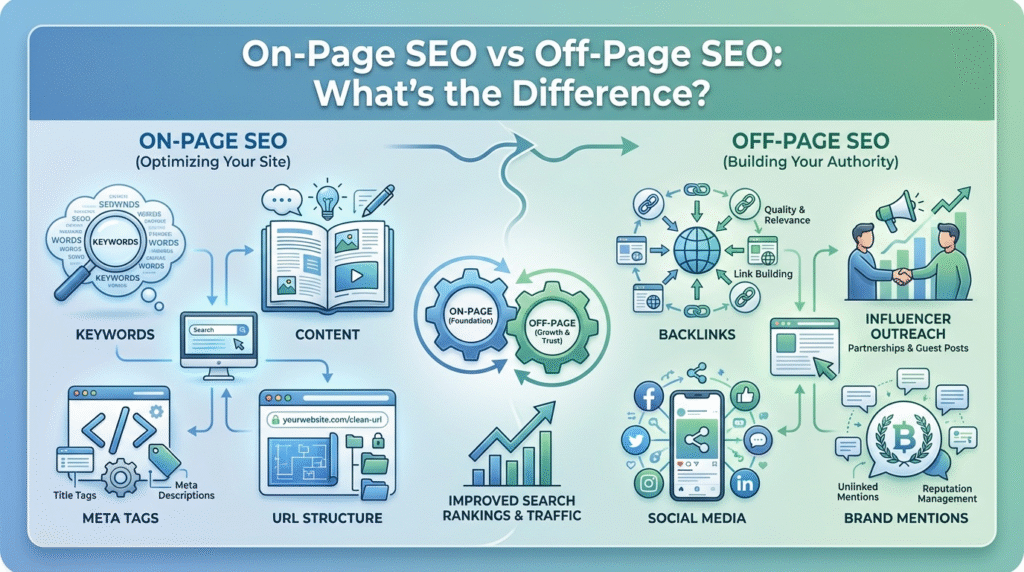
Think of on-page SEO as decorating inside your house and off-page SEO as building your reputation in the neighborhood.
On-page SEO includes everything on your website: content, titles, images, and structure. Off-page SEO is about getting other websites to link to you and mention your brand.
You have complete control over on-page SEO. You can change your titles, improve your content, and fix your images anytime you want. Off-page SEO depends on other people’s actions.
How to Optimize Your On-Page SEO: A Step-by-Step Guide
Ready to improve your pages? Here’s my simple process for on-page optimization:
- Pick Your Target Keyword: Choose one main keyword per page. Use keyword research tools to find what people actually search for.
- Write a Compelling Title: Include your keyword and make it interesting. Think about what would make you click.
- Create Quality Content: Write helpful, comprehensive content that answers user questions completely.
- Structure with Headings: Use H1, H2, and H3 tags to organize your content logically.
- Optimize Your Images: Add alt text, use descriptive file names, and compress for fast loading.
- Add Internal Links: Link to other relevant pages on your site when it makes sense.
- Check Your Page Speed: Use tools like Google PageSpeed Insights to identify and fix speed issues.
Common On-Page SEO Mistakes That Hurt Your Rankings
I’ve made these mistakes, and I see others making them too. Here’s what to avoid:
- Keyword Stuffing: Don’t repeat your keyword unnaturally. It sounds robotic and Google hates it.
- Duplicate Content: Each page should be unique. Don’t copy content from other pages or websites.
- Missing Title Tags: Every page needs a unique, descriptive title tag.
- Ignoring Mobile Users: Make sure your site works perfectly on phones and tablets.
- Slow Loading Pages: Compress images and fix technical issues that slow down your site.
- Poor URL Structure: Use clean, descriptive URLs instead of confusing strings of numbers and symbols.
Conclusion
Learning what is on page seo changed everything for my website. It’s not rocket science – it’s just about making your pages helpful and easy to understand for both people and search engines.
Start small. Pick one page and optimize it properly. Write a better title, improve your content, add some internal links, and optimize your images. You’ll be amazed at the difference it makes.
Remember, on-page SEO is like tending a garden. It takes time to see results, but the effort is worth it. Every small improvement you make gets you closer to ranking higher and attracting more visitors.
Don’t try to do everything at once. Focus on one element at a time, and before you know it, you’ll have a website that both Google and your visitors love.
Frequently Asked Questions
What is on-page SEO exactly?
On-page SEO is the practice of optimizing individual web pages to rank higher in search engines. It includes everything you do directly on your website like improving titles, content, headings, images, and page structure. Think of it as organizing and decorating each room in your house to make visitors comfortable.
What are the most important on-page SEO factors?
The most important factors are high-quality content, title tags, headings structure, page speed, and mobile-friendliness. Content quality matters most because Google wants to show users helpful, accurate information. The technical elements help Google understand and rank your content properly.
How is on-page SEO different from off-page SEO?
On-page SEO happens on your website and includes things you control directly like content, titles, and images. Off-page SEO happens outside your website and includes backlinks from other sites and social media mentions. You have complete control over on-page SEO but less control over off-page factors.
What are title tags and meta descriptions?
Title tags are the clickable headlines in search results and browser tabs. Meta descriptions are the short summaries that appear under titles in search results. Title tags directly affect rankings, while meta descriptions help people decide whether to click on your page.
How do I optimize my content for on-page SEO?
Write helpful, comprehensive content that answers user questions completely. Include your main keyword naturally in the title and first paragraph. Use headings to organize information clearly and add related keywords throughout the content. Focus on being useful rather than just including keywords.
What is the role of keywords in on-page SEO?
Keywords help Google understand what your page is about and when to show it in search results. Use your main keyword in the title, first paragraph, and some headings naturally. Also include related keywords (LSI keywords) that provide context and help Google better understand your topic.
How important are headings for SEO?
Headings are very important because they create structure and help both users and Google understand your content organization. Use one H1 tag for your main title, H2 tags for major sections, and H3 tags for subsections. This creates a clear hierarchy like an outline.
What is URL structure in on-page SEO?
URL structure refers to how your web page addresses are formatted. Good URLs are short, descriptive, and include relevant keywords. Use hyphens between words and avoid confusing numbers or symbols. Clean URLs help both users and search engines understand what the page contains.
Do images affect on-page SEO?
Yes, images significantly affect on-page SEO. They impact page loading speed, which is a ranking factor. Use descriptive file names, add alt text for accessibility, and compress images for faster loading. Optimized images improve user experience and help your pages rank better.
How long does on-page SEO take to work?
On-page SEO improvements typically take 3-6 months to show significant results in search rankings. However, some changes like improved page speed can help user experience immediately. Google needs time to crawl and re-evaluate your pages after you make optimizations.
Can I do on-page SEO myself?
Absolutely! On-page SEO is very doable for beginners. You don’t need coding skills for most optimizations like improving titles, content, and images. Start with the basics like writing better titles and creating helpful content. Many tools can guide you through the process step by step.
What’s the difference between on-page SEO and technical SEO?
On-page SEO focuses on content and visible page elements like titles, headings, and images. Technical SEO deals with behind-the-scenes factors like site speed, mobile-friendliness, and website structure. Both work together, but on-page SEO is more about content while technical SEO is about website performance and crawlability.